>> Eat the World Los Angeles: El Salvador
Showing posts with label El Salvador. Show all posts

Monday, 7 November 2022

Panes La Chata

Women working at the corner stand

๐Ÿ‡ธ๐Ÿ‡ป EL SALVADOR
๐Ÿ“ 12004 Vanowen Street, North Hollywood, San Fernando Valley
๐Ÿ…ฟ️ Street Parking
๐Ÿ’ฒ Cash Only
๐Ÿฅค No Alcohol

If you grew up in El Salvador, the coming winter months would signal the arrival of pan con pollo season, a uniquely Salvadoran sandwich that is often eaten around the holidays and especially during new year celebrations. It is unlike the versions found in neighboring countries like Guatemala and Honduras despite sharing a name, always a long-simmered chicken stuffed in a fat, puffy roll.

While you will find Salvadoran tortas and sandwiches that kill children on the streets of any city, panes con pollo are a bit more rare and usually made at home. They require extensive cooking of the chicken, which spends a lot of time simmering on the stove made as a guisado (stew). This makes finding Panes La Chata in North Hollywood all the more special, offering panes con pollo (below) three evenings a week since spring on the corner in front of the proprietor's residence.

Pan con pollo

Translated as "bread with chicken," this celebratory sandwich is much more than that, served with a mountain of vegetables on top of the stewed chicken and a side cup of gravy straight from the pot it was cooked in. While it might not seem like it from a small photo, the sandwich is gigantic, filling a regular styrofoam takeout container from corner to corner.

A pan con pollo is assembled when ordered so the bread does not get soggy from the delicious guisado. The gravy is served on the side and should be poured on when you are ready to eat. You do not see chairs or seating here at the tent, so take this home, pull up a chair at the table, and lean in. It is going to be messy. Once you find pieces of dark meat underneath the garden of beets, tomatoes, carrots, and more, be careful as some are still on the bone.

Five canoas de plรกtano ready to be served

Sometimes you will see a sandwich board set out on the sidewalk with other options, but on this day the Santa Ana Winds were howling through the Valley so a conversation needed to take place to see what was on offer. The lid of a metal tray was lifted to reveal canoas de plรกtano (above), a dessert of ripe sweet plantains fried and filled with a cream made from milk, condensed milk, sugar, and eggs.

These "canoes" show up in bakeries all over El Salvador and can be ordered in many typical casual restaurants, a favorite for those that need to take care of a sweet tooth. A syrup or liquid sugar drizzle of some kind is put over the top and spooned into your takeout container, as well as raisins and cinnamon lined up in the boat.

Bean empanada with tomato salsa

On many weekends you can also find small Salvadoran-style tamales pisques (above), a corn masa treasure stuffed with refried beans and steamed in banana leaves. Using these instead of corn husks makes the final product very moist, as none of the fats or oils from the beans can escape while steaming and gets infused into the masa. It is just a few bites and should be combined with their homemade tomato salsa, which comes on the side.

If you see a row of brown paper bags, you know you are in luck and there are still quesadillas available. Quesadilla salvadoreรฑa (below) is a sweet bread that is cooked with hard white cheese inside of it, a combination of flavors that are all subtle enough to be enjoyed especially well with coffee. Make sure to take one home for the next morning, as it makes the perfect companion to your favorite hot beverage.

Quesadilla salvadoreรฑa served with coffee in the morning

Look for the stand during evenings on Thursdays, Fridays, and Saturdays, in front of the Park Vanowen Apartments at the corner of Vanowen Street and Ben Avenue. This is also the residence of the three generations of women you will find operating the stand (and four if you count the family inside), so the freshly cooked guisados and baked goods are ready to go close to the source.

They are also really good people, and a joy to chat with and learn more about these foods. The pride they show in their cooking, especially if you can speak a bit of Spanish with the older two, is as clear as a day the Santa Anas blow away the smog out of Los Angeles.

๐Ÿ‡ธ๐Ÿ‡ป๐Ÿ‡ธ๐Ÿ‡ป๐Ÿ‡ธ๐Ÿ‡ป

I COULD USE YOUR HELP
Eat the World Los Angeles is and always has been free. It is a hobby born of passion and never solicits money or free food from restaurants. No advertisements block the content or pop over what you read. If this website has helped you explore your city and its wonderful cultures a little better please tell your friends about us and if you have the means to contribute, please consider doing so. Eat the World Los Angeles is a labor of love, but also takes a lot of money and time everyday to keep running.

Thank you!
VENMO: @JAREDCOHEE
CASH APP: $JaredCohee
PAYPAL: (no account necessary, use link)

Wednesday, 11 May 2022

Don Lencho

EL SALVADOR ๐Ÿ‡ธ๐Ÿ‡ป
Normandie Avenue facade


EDITOR'S NOTE: An updated version of this article (11 October 2025) is available as part of the Free Friday Favorites section of our Substack page. Check that out here:

If you have ever spent any time in El Salvador and Central America, away from the resorts, using public transportation and going to restaurants that local families patronize, walking into the back patio of Don Lencho will immediately bring back memories. While the (now unused) walk-up window in front speaks of California, there is no greater portal to the Pacific Coast of El Salvador than the dining area of this grilled fish specialist in South Los Angeles, just a block away from Harvard Park.

Even the tin-forward surfaces of this Salvadoran mainstay speak of the shacks along the coast that feed locals and travelers alike. Football is usually on the small television, the smoke from the grill is partially trapped underneath the roof, and the flies pick on the discarded bones of at least one grilled fish from every table. If you did not hear the singing and soul-saving amplified from storefront churches along busy Normandie Avenue and see the stacks of tires at the used car lot next door, Don Lencho would fool you into thinking the beach was close.

People lined up for takeout orders

One of every five reviews online is from someone that has bad things to say about the neighborhood or the environment at the covered outdoor restaurant, but how many places these days can say they have been open since the early 90s? They have expanded their reach without really expanding the kitchen, so there can be a wait, but the staff is friendly and drinks like maraรฑรณn (seasonal), chan, and horchata are nice to sip on in the meantime.

Half of the flavor of most items here come from the mesquite grill that is basically in the center of the patio but unseen behind a wall. The smoke circling its way out is a constant reminder that they are hard at work and your order is going to make it. You can start to see and smell this smoke as you walk up to the restaurant if you have not parked in their tiny lot.

A Sunday order at Don Lencho

Weekends are usually busier here, with specials of sopa de gallina on Saturdays and sopa de pata on Sundays. Some couples might be at a table here and there, but most wrangle the whole family or a group of friends to share as many of their big plates as possible. The menu is quite small and focused, so it does not take much energy to choose your order.

The sign in the front should guide your decisions on your first time visiting, Don Lencho claims to specialize in mojarra asada and as a pupuseria. Pupusas ($3.75 each, below) come in standard corn or rice flour for a quarter more. Unfortunately there is enough ambient noise that you do not hear them being patted out when ordered, but when they arrive a napkin might be required to catch the drool forming on your lips.

2 Pupusas

Pupusas have a dark char on them from getting the same treatment as the meats over mesquite. Like you can imagine, that flavor is in every bite, especially the beautiful burnt oozing cheese that has made its way out of the masa during cooking. They have all the standard options like loroco, chicharrรณn, frijoles, and do them all very well, but make sure to cover them in the house-made curtido and salsa that comes with each order.

This cabbage relish is slightly fermented and full of sharp flavors and crunchiness that complement the tastes and textures of a pupusa perfectly. The salsa de tomate is not spicy at all but is delicious nonetheless. Orders of pupusas to go include generous amounts of both, showing how much the place insists on quality and how proud they are of everything.

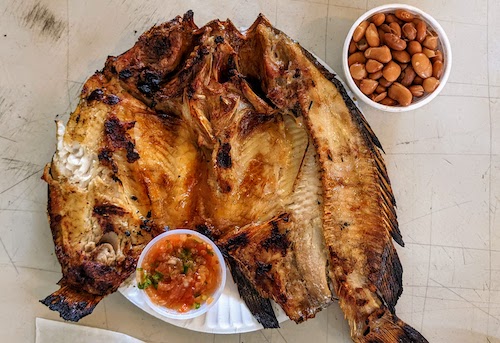
Mojarra asada

The specialty of the house and something you see on every table almost without exception is the mojarra asada ($20, above), a split tilapia grilled over mesquite and served simply on a paper plate with a cup of beans like your favorite joint in La Libertad does. The "marinade" is probably just a bit of salt, but the combination of this, the mesquite grill, and a chef who cooks every fish perfectly make this full of wow factor.

Anyone can deep fry a fish, the reason mojarra frita is ubiquitous on the menus of Central American and Mexican menus. This fact makes Don Lencho stand out and worth coming from all around Greater Los Angeles to enjoy.

Carne asada plate

If you have enough people or can resist an order of mojarra asada on a second visit, the three other grilled meat options are as satisfying as expected coming from the same grill. A carne asada plate ($16, above) is a good start, a thin fatty cut of beef with plenty of black char and infused smoke. It may be a struggle with the plastic utensils, but honestly the joy already a part of the table is enough to forget all that.

The rice and beans that come with these plates could be described as workaday, nothing special but definitely go well with chunks of the meat. The house salsa will come with each, so you will not have to ration it if those tastes make you appreciate everything more.

Chorizo plate

A chorizo plate ($15, above) comes with five small connected links of the cured and spiced pork sausage, also charred from the grill and served with rice and beans. The interiors of these are purposefully a bit dry but the combination of paprika, garlic, green chile, and onion will bring the taste of back home to a Salvadoran's mouth.

The restaurant also does a grilled quail, which will be added here if ever sampled as will be the weekend soups. You can get grilled corn and atol de elote as well, but not much more. This is the secret of Don Lencho, who knows what they do well and makes sure every order is always just right.

๐Ÿ‡ธ๐Ÿ‡ป๐Ÿ‡ธ๐Ÿ‡ป๐Ÿ‡ธ๐Ÿ‡ป

I COULD USE YOUR HELP
Eat the World Los Angeles is and always has been free. It is a hobby born of passion and never solicits money or free food from restaurants. No advertisements block the content or pop over what you read. If this website has helped you explore your city and its wonderful cultures a little better please tell your friends about us and if you have the means to contribute, please consider doing so. Eat the World Los Angeles is a labor of love, but also takes a lot of money and time everyday to keep running.

Thank you!
VENMO: @JAREDCOHEE
CASH APP: $JaredCohee
PAYPAL: (no account necessary, use link)

Tuesday, 29 March 2022

El Chalet Tortas Hula Hula

E. 87th Street residence

๐Ÿ‡ธ๐Ÿ‡ป EL SALVADOR
๐Ÿ“ 1130 E. 87th Street, Florence-Firestone, South Los Angeles
(On Google Maps it will be close, but this address should be used)
๐Ÿ…ฟ️ Street Parking
๐Ÿ’ฒ Cash Only
๐Ÿฅค No Alcohol
 
EDITOR'S NOTE: This business is no longer operating. An updated version of this article (03 October 2025) is available as part of the Historical section of our Substack page. Check that out here:

For a variety of factors which all food entrepreneurs in Southern California face, the setup of Tortas Hula Hula has necessitated a frequent bounce from place to place around South Los Angeles. Thankfully, the new setup has literally brought owner and chef Oscar Cortez home to a quiet street between busy avenues at the southwestern edge of Florence-Firestone. Surrounded by a beautiful old Datsun and all the other stuff that comes from living in the same place for decades, his weekends-only Salvadoran sandwich stand is still going strong and is now called El Chalet Tortas Hula Hula.

The offerings are the types of things that most non-Salvadoran people might not find destination-worthy, but the smiles on the faces of expat customers tell a different story. These people are busy being carried back to their childhoods with some common foods they took spare change to after school to buy from vendors on the street. The stand is named after a specific torta that was named after a specific park in San Salvador where street chefs first started selling the creation.

Torta estilo hula hula

The meats inside a torta hula hula ($10, above) are a freshly-griddled hamburger patty cut in half and placed on each side as well as a couple slices of deli ham. The tastes that make this so much like those found back home are the pan flauta it is all put on, and the combination of homemade curtido mixing inside the bread with mayonnaise and ketchup. An avocado has been spread on each side of the bread as well. Some bottles of mostly Mexican hot sauces are on the table, but do not pass the chance to try some Trompa de Chucho, which has a growling rottweiler on the front and bills itself as the hottest sauce in El Salvador.

If the heat gets to you, order a big glass of their homemade horchata ($5, not shown), more nutty and earthy from its use of seeds compared to rice in the Mexican version. You can also add more curtido to each sandwich as their is a giant tub on each table. On a second visit or if you come with friends, try another popular sandwich called mata niรฑos, which if your Spanish is limited you may think is an option for children. The name has many theories about its origin, but you can just play around making up your own and it will probably be just as close. Also called panes cheveres in parts of El Salvador, this sandwich has mortadella combined with curtido, mayonnaise, and ketchup, and is just as popular as the hula hula. Please do not harm any children.

๐Ÿ‡ธ๐Ÿ‡ป๐Ÿ‡ธ๐Ÿ‡ป๐Ÿ‡ธ๐Ÿ‡ป

I COULD USE YOUR HELP
Eat the World Los Angeles is and always has been free. It is a hobby born of passion and never solicits money or free food from restaurants. No advertisements block the content or pop over what you read. If this website has helped you explore your city and its wonderful cultures a little better please tell your friends about us and if you have the means to contribute, please consider doing so. Eat the World Los Angeles is a labor of love, but also takes a lot of money and time everyday to keep running.

Thank you!
VENMO: @JAREDCOHEE
CASH APP: $JaredCohee
PAYPAL: (no account necessary, use link)

Monday, 19 July 2021

Restaurante Y Pupuseria El Manรก

EL SALVADOR ๐Ÿ‡ธ๐Ÿ‡ป

EDITOR'S NOTE: An updated version of this article (28 October 2024) is available as part of the Historical section of our Substack page. Check that out here:

It may not be the most beautiful stretch of Jefferson Blvd. in South Los Angeles, but the blue and white metal bars on the window, awning, and hand-painted signs are just a wave of what is in store for diners who choose to stop in and eat. Inside the door, and on the other side of the unused bullet-proof glass partitions that seem made for a different era, a small five table dining room is surrounded by paintings and pictures of El Salvador, a few Guatemalan handicrafts, and most interestingly a wide photo of Jerusalem.

But the menu does not stray from la patria salvadoreรฑa, starting with breakfast, a wide range of pupusas, soups, seafood, and carne asada. Originally the business began in a local home, but got popular enough almost a decade ago that it needed to expand into its own space.

Opening at 09:00 six days a week, El Manรก is a great and popular place for breakfasts, with many different options for enjoying your eggs. One of the most delicious ways is a plate of huevos con loroco ($11, above), which also comes loaded with beans, fried sweet plantains, crema, queso, and a slice of avocado like any reputable Central American breakfast should.

Loroco only grows natively in El Salvador and its neighbors, but thankfully Los Angeles is close enough and has enough demand to make sure that the edible green buds of this flowering vine are available for pupusas and scrambled eggs at Salvi restaurants. They are often enjoyed in pupusas but may be allowed to shine brighter when eaten like this in eggs.

Whether with loroco or with cheese, beans, and chicharrรณn, pupusas ($3 each, above) are all freshly patted out with the ingredients of your choice and expertly griddled. They tend to leave them on just a bit longer here, giving you plenty of crispy cheese oozed out and fried.

A tub of zesty curtido and squeeze bottle of tomato salsa are brought out automatically with any pupusa order and should be applied liberally. While there may be a fork and knife on the plate as well, do note that the proper way to eat these are with your hands, risking burning your fingertips when they come out fresh.


On a recent visit, another customer was receiving an order of camarones al mojo de ajo ($14, above), which looked and smelled irresistible. These freshly prepared big shrimp are zesty with a thin gravy of garlic sauce and are served with rice and beans. Spritz on a few slices of lime to play with the heavy buttery nature, and combined with bites of rice and beans there is pure bliss.

Next visits once the heat subsides just a bit will explore soups like the always satisfying sopa de gallina, more of the tasty ways they prepare shrimp, and pollo en crema. And of course more pupusas, which can also be ordered here with chicken, carne asada, shrimp, and flor de calabaza and made with rice flour if desired.

๐Ÿ“ 2511 W. Jefferson Blvd., Jefferson Park, South Los Angeles

๐Ÿ‡ธ๐Ÿ‡ป๐Ÿ‡ธ๐Ÿ‡ป๐Ÿ‡ธ๐Ÿ‡ป

I COULD USE YOUR HELP
Eat the World Los Angeles is and always has been free. It is a hobby born of passion and never solicits money or free food from restaurants. No advertisements block the content or pop over what you read. If this website has helped you explore your city and its wonderful cultures a little better please tell your friends about us and if you have the means to contribute, please consider doing so. Eat the World Los Angeles is a labor of love, but also takes a lot of money and time everyday to keep running.

Thank you!
VENMO: @JAREDCOHEE
CASH APP: $JaredCohee
PAYPAL: (no account necessary, use link)

Monday, 16 December 2019

Van Nuys Pupusa Stand (Isabel)


๐Ÿ‡ธ๐Ÿ‡ป EL SALVADOR

EDITOR'S NOTE: An updated version of this article (22 December 2023) is available as part of the Historical section of our Substack page. Check that out here:
 
Los Angeles is a city that certainly does not make it hard to find pupusas. Salvadoran enclaves are spread out in many parts, from north to south, making restaurants and sidewalk stands readily available to hungry folks. The latter can be found especially prevalent on weekends, when from early morning hours in South Los Angeles or near MacArthur Park the familiar and comforting sound of fresh pupusas being patted out is like a siren song.

And while they have differences, Central Americans are no strangers to eating tacos as well, something of a national dish of Los Angeles. As you can find any night over at the Guatemalan night market in Westlake, fresh tortillas are thicker and often have big cuts of just-grilled meats. This style of taco is more common with Salvadoran vendors as well, and following a friendly lead to Van Nuys turned up the three nights a week operation of Isabel, who cooks both pupusas and tacos on Victory Blvd in front of an apartment complex.


The corn flour masa mix is ready on standby, but the rest of its birth must take place after ordering to ensure the best result. At some high volume pupusa stands they might have many going so that wait times can be lower, but it is really worth it regardless. That aforementioned "pat pat pat" almost works as a direct signal to the stomach, with hunger pangs shooting back up in return.

Beans and cheese are added before flattening out and then the pupusa is thrown on the charcoal comal. Quite a few flips and about ten minutes later your order is ready, the temperature hovering somewhere around that of the surface of the sun.


An entire table is dedicated to toppings and salsas for everything. The two traditional toppings are pickled cabbage (curtido) and a slightly sweet and non-spicy tomato salsa, as seen above. There are plenty of other vegetable and salsa options as well, mostly to accompany orders of tacos, but to be honest there are no rules so go to town. The only pro tip is that pupusas are meant to be eaten by hand. This of course can be tricky given how hot it is and how hungry you are, but it is unlikely you will be heckled for using a knife and fork.

Even more popular than the pupusas and seemingly the reason the other patrons had come was for tacos and other plates of all grilled meats. Chicken, pork, ribs, sausages, intestines and more are available, all to be hacked up when ready and placed on nice thick homemade tortillas.


Back on the condiments table there are pickled cucumber slices and other vegetables, limes ready for squeezing, and a selection of salsas to find just the right combination. You could come here for three nights straight and make different tacos for yourself. Thick cuts of meat are seen below with nice marinades and a layer of char from the grill.

Life does not get much better than taking your bounty to the provided table and sharing it with other neighbors who have brought their families to eat here. The stand is currently open three nights a week, Friday through Sunday, from 16:00 to 22:00.


๐Ÿ‡ธ๐Ÿ‡ป๐Ÿ‡ธ๐Ÿ‡ป๐Ÿ‡ธ๐Ÿ‡ป
VAN NUYS San Fernando Valley
14124 Victory Blvd

Sunday, 10 March 2019

Pupuseria Comalapa


๐Ÿ‡ธ๐Ÿ‡ป EL SALVADOR

EDITOR'S NOTE: An updated version of this article (08 December 2023) is available as part of the Historical section of our Substack page. Check that out here:
 
While the area of present day Bell Gardens has a history spanning centuries with indigenous peoples then Spanish then as part of Mรฉxico, it was named in the 1920's like its neighbor Bell after some white settler James George Bell. Before that it was known for some of the most fertile land in the area, part of a floodplain that attracted immigrants from Japan who turned some of it into rice fields.

Besides being home to one of the last two remaining Pioneer Chicken restaurants, nowadays Bell Gardens is home to 95.7% of people who identified on the 2010 census as "Hispanic or Latino of any race." As such, there is a high concentration of Central Americans and especially Salvadorans, with pupusas not hard to find anywhere on this side of the Los Angeles River.

Across the street from that Pioneer Chicken is a pupuseria at the back of a small strip mall named Bell Gardens Plaza. Comalapa is named for the municipality about 40km southeast of the capital San Salvador that used to also be the name of its international airport, a hub which features prominently on the menu here.


The dining room is full of everything guanaco you could imagine, starting with a large flag and plenty of blue paint. Frames, prayers, and touristy objects all hang from the walls slightly askew. No matter whether the restaurant is empty or full, there seems to be just one person running the entire dining room, which is a point of contention noticeable from online reviews, but come here with some time and an open mind and you will not be disappointed.

After you put in an order for pupusas, you will hear the distinctive "pat, pat, pat" of the discs being made fresh in the kitchen before getting put on the grill. This is a comforting sound somehow, full of love. If you are not Salvadoran, maybe it taps into a previous life when you were, the sounds of the kitchen as heard by a child.

Often times at pupuserias, small dishes of curtido, the essential fermented cabbage side, and a tomato salsa arrive with your order. Here they don't play, as a gigantic container of each shows up and makes rationing unnecessary.


If you notice a very slight difference in color above (and more closely below), that is because the pupusa on the left is made from rice flour instead of the more "normal" corn. Often times Salvadoran restaurants can make these but do not advertise them on the menu, sort of a need-to-know basis for folks that might want them. They are worth trying if you have not before, a full shift in texture and flavor profiles. The rice is dense and chewy, but with a slightly sweet and more subtle flavor than corn, allowing the ingredients to shine through just a touch more.

The history of rice pupusas are anecdotes that range from necessity during corn shortages to the ease and inventiveness of Salvadoran people, but as these lands of Bell Gardens used to be growing rice, it is at least interesting to ponder and appreciate while you wait for them to arrive.

Either way you prefer them, they are terrific here.

<--- RICE / CORN --->

Make sure not to order more of the rice variety than you can eat at this sitting though, for they absolutely cannot be warmed up later. When rice pupusas cool, they turn dense and undesirable, and will have to be thrown away.

Horchata de morro ($2.25, below) is a distinct Salvadoran style of horchata made from ground calabash seeds and very earthy. As I thought more about the rice fields, for a moment I could almost taste the grain again.


While this is the original location, the owners also now have a second location down in Bellflower which seems to get the same amount of positive attention for their food.

๐Ÿ‡ธ๐Ÿ‡ป๐Ÿ‡ธ๐Ÿ‡ป๐Ÿ‡ธ๐Ÿ‡ป